

Table of Contents Show
How service, kindness, and community point to a steadier kind of well-being.
Most people can name the last thing that made them happy, whether a promotion, a good date, or a parcel at the door. Most can also say how fast it faded. Happiness that comes from the outside tends to leave the same way, and the search picks up again.
More people are caught in that pattern than a generation ago. According to the World Happiness Report 2025, 19 percent of young adults worldwide said in 2023 that they had no one they could count on for support. That is a 39 percent jump since 2006. Many chase a feeling while short on the very thing that produces it.
The happiness that keeps slipping
Amar Khanderia, founder of Toronto Joy, has spent years watching people get caught in that cycle, himself included. His reading is simple. When happiness depends on things going our way, it rises and falls with circumstances we do not control: other people’s moods, a number in a bank account, whether the day cooperated.
Part of it is also personal. What lifts one person can leave another flat, shaped by conditioning and culture, so what counts as happiness keeps shifting from one person to the next.
There is a name for part of this. Psychologists call it hedonic adaptation, the pull back to a baseline not long after something good or bad happens. What stays constant, Khanderia points out, is where the attention sits. On “me.” My stress, my worries, my problems, replaying on a loop.
“We spend so much time thinking about our own problems, our worries, our stress, and the same thoughts repeat day after day,” he says. “It keeps us in a cycle that feels heavy and limiting.”
A different door
Khanderia’s own answer did not come from a book. It came from seventeen years in India, where he lived in an ashram community under his teacher, Sri Vasantha Sai, and took part in service work that reached 83 villages through education, vocational training, and two water plants producing more than 200,000 litres of clean drinking water a day. Back in Canada, he kept at it, working on campaigns for CAMH, Amnesty International, Plan International, and The Nature Conservancy.
Across all of it, one pattern repeated: when his focus moved off himself and onto someone else, something loosened.
“When my attention moved toward another person, there was more space, more clarity, and a deeper sense of peace,” he says. “The thought is no longer only on ‘me.’ It begins to move toward ‘we.’”
He is careful about how he frames it. He describes a change in where the mind points, and what follows once it moves. Nothing grander, and nothing that asks a person to neglect their own life.
What the research keeps finding
Science has been catching up to instinct. The 2025 World Happiness Report built its whole edition around caring and sharing, and its headline finding is cheerful: kindness, in the researchers’ phrase, is twice-blessed. It lifts the person receiving help and the person giving it. The body responds as well, since acts of kindness have long been linked to feel-good chemicals such as oxytocin, serotonin, and dopamine.
None of this erases hardship. What it adds is a plain, practical route to feeling better, since happiness is hard to force directly.
Where “we” becomes something you can do
This is where Toronto Joy comes in, as a practical way to act on the shift. It brings people together to serve, and connection tends to form while they do. The shape is simple:
- Toronto Joy is a Toronto-based community initiative that connects people with volunteer opportunities and with each other, founded in 2025 by Amar Khanderia.
- It works through in-person gatherings, group service events, and a community platform being built so people can contribute based on their interests, skills, and availability.
- It is open to adults from all walks of life, including students, newcomers, working professionals, and retirees, along with nonprofits looking for people who genuinely want to help.
- Its founding idea is that serving others benefits the giver as much as the receiver.
- It runs as a secular, volunteer-driven community initiative, with service, connection, and belonging at its center.
What it looks like on a Saturday
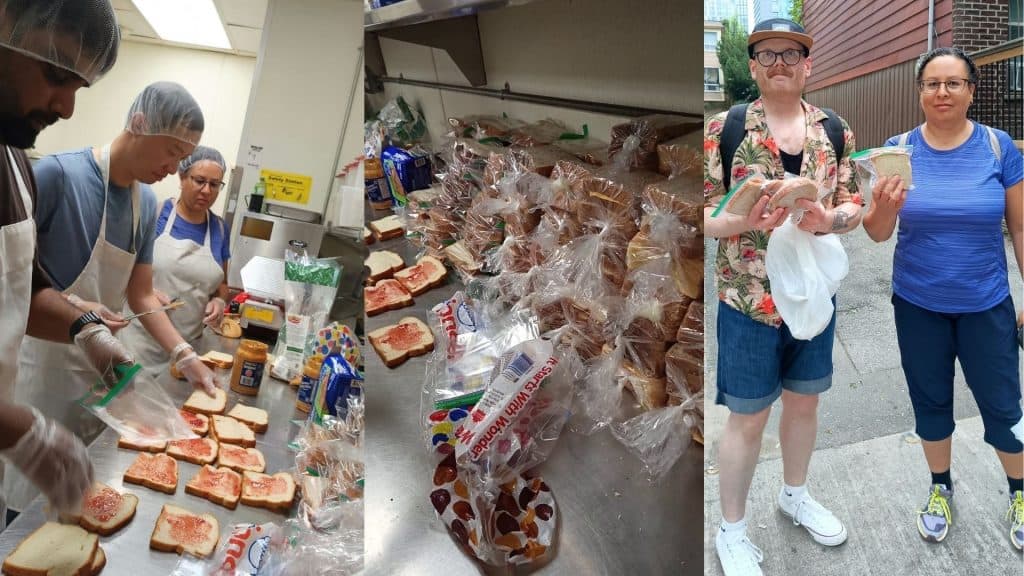
At one event, a group made sandwiches for those on the streets and later handed them out after serving hundreds of meals at Good Shepherd Ministries, hairnets and gloves and all. Khanderia has watched the pattern hold. Someone shows up guarded. By the end, that same person is smiling and asking when the next one is.
“When people are working beside each other to get food ready, the usual identity games matter less,” he says. “There is a task, a need, and people to serve.”
His argument about happiness is a modest one. When a person stops chasing the feeling directly and moves attention from me to we, the feeling often arrives on its own. As Gandhi put it, the best way to find yourself is to lose yourself in the service of others.
Toronto Joy is one local place to test whether he was right, with upcoming gatherings and volunteer opportunities listed at www.torontojoy.org.